Why the Tokyo Marathon Belongs on Your Bucket List
Some marathons earn their reputation through marketing. Tokyo earns it through execution.
We've spent a lot of time reading race reports, studying course data, and modeling conditions for March 1st. Every data point points in the same direction: Tokyo is one of the most thoughtfully designed races in the world. Runners talk about it differently than other Majors. Less hype, more quiet respect.
That's worth paying attention to.
The most weather-stable Major on the calendar
If you look at the last ten years of race-day conditions, Tokyo is an outlier. In the best way.
Eight out of ten years were thermally optimal for a 3-hour marathoner. Look at the actual numbers: 2016 through 2024 shows heat impacts of 0.0% across almost every edition. Zero slowdown. The only exception in recent memory was 2025, when temperatures reached 14→18°C and cost runners around 2 minutes 12 seconds. Before that, you have to go back to 2020 (which was eventually cancelled) to find meaningful heat impact.
That kind of consistency is genuinely rare across the World Marathon Majors.
Early March in Tokyo typically means a start temperature around 8–11°C, gradual warming through the morning, manageable humidity, and 0% precipitation probability. In other words: conditions where your fitness gets to show up.
But "stable" doesn't mean "irrelevant." This year's forecast is the clearest example of that.
This year: cool start, but watch the back half
The current 4-day forecast tells a specific story.
Start at 9am: 11°C, feels like 8°C. Comfortable. Manageable. By 10am at the 11.7km mark, you're at 12°C. By noon at 39.9km - the point where most marathons are either won or lost - you're looking at 14°C, feels like 13°C.
That's a 3°C rise across the race. It sounds modest. It isn't.
Based on 70 simulations across three different weather models, the expected heat impact for a 3-hour marathoner this year is around +40 seconds total. Not catastrophic. But real, and almost entirely concentrated in the final 10km when you're already under pressure.
Wind looks favorable. The forecast shows 13.4 km/h at the start, dropping steadily to 8.8 km/h by the time the last runners finish. Direction is mostly from the southwest, which aligns well with the course layout.
Your goal pace is not automatically your race pace. That's the main thing to take away here.
Wind: direction beats speed
The historical wind data backs up what the course layout suggests: Tokyo is rarely disrupted by wind.
Looking at the last ten years, wind impact with drafting has been negligible in almost every edition - fractions of a percent. Even without drafting, only 2024 exceeded a 1% slowdown (coming in at 1.3%, or about 2 minutes 25 seconds for a 3-hour runner). Every other year was well under that threshold.
What matters more than raw wind speed is direction relative to the course. Tokyo's layout prevents long sustained headwind sections, which is where wind actually costs you time. When you're in a dense field - which Tokyo reliably delivers - the impact drops further.
Wind is not the variable to worry about this year. Temperature is.
A course that looks flat - and runs faster than flat
Tokyo is described as flat and fast. That's accurate, but it undersells something.
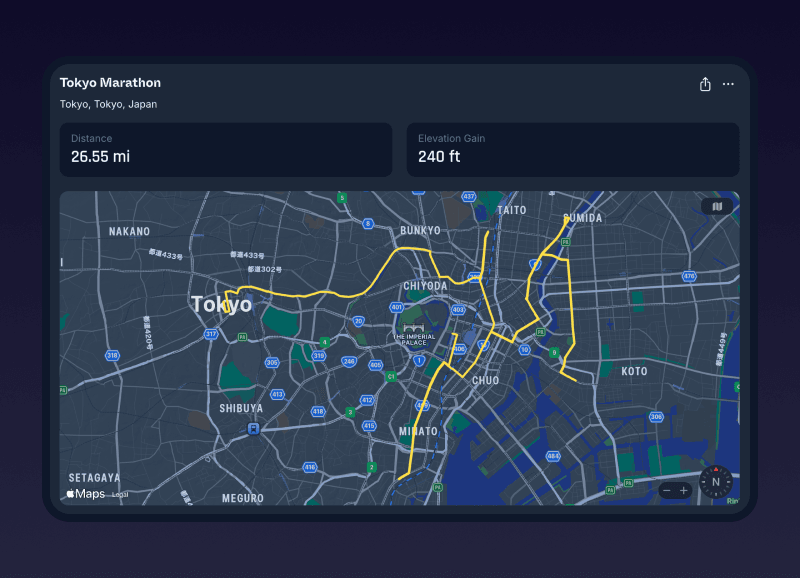
The elevation profile drops from 46m at the start to a low of 7m around the 10km mark, then holds relatively flat through the rest of the course. Total gain is 55m. Total loss is 85m. That net downhill is meaningful.
There are three U-turns on the course that cost roughly 10–15 seconds compared to Berlin's cleaner layout. But the net downhill more than offsets that.
For a 3-hour runner, Tokyo models out to approximately 15 seconds faster than a perfectly flat course. The pace delta chart confirms it: you bank a few seconds in the early kilometers and give back almost nothing over the flat middle section. The terrain works quietly in your favor if you let it.
97% of the course sits in the -2% to +2% gradient band. There are no climbs to blame, no terrain excuses. Just you and your pacing decisions.
A Major that actually feels elite
Tokyo's place among the World Marathon Majors reflects how the race is run, not just its city.
Logistics are clear. Corrals move efficiently. Aid stations are calm. The start line is quiet, almost focused. Less noise, more intent.
Many runners describe it as being invited to run well rather than swept along by spectacle. That subtle difference shapes the entire experience.
The culture changes how a race feels
Japan's distance running culture is deep. High mileage is common. Pacing is studied and respected. Execution matters.
Tokyo regularly sees an unusually high density of sub-2:30 finishers, but that's not the interesting part. What stands out is the depth behind the elites. Mid-pack runners describe being surrounded by people running evenly and intentionally throughout.
That changes things. When the runners around you are steady, you're less tempted to surge early. When restraint is the default, it's easier to practice.
Tokyo doesn't just host a marathon. It reflects a running philosophy.
Why it's still on the list
We've studied the charts. Modeled the pacing shifts. Compared the elevation data. And honestly, that's made us want to run it more, not less.
There's something rare about a race where the data and the reputation point in the same direction. Eight out of ten years with zero heat impact. Wind that rarely disrupts. A course that quietly rewards disciplined pacing. A culture that actually respects the marathon.
Most bucket list races earn their place through atmosphere or scenery. Tokyo earns it through consistency. It's a race where preparation tends to show up on the clock - and that might be the purest version of what a marathon should be.
It'll happen. Just not yet.