Which Running Distance Is Right for You?
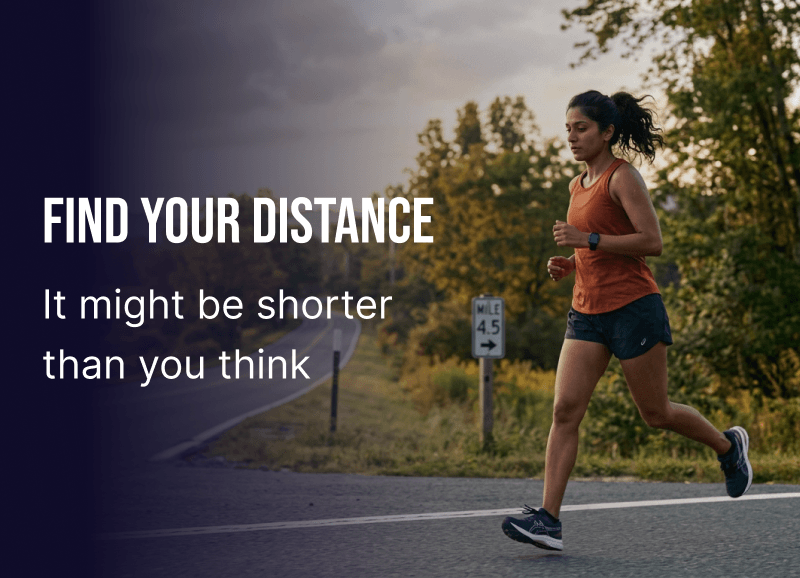
Most runners default to the marathon. It's the most visible distance, the most talked about, and somewhere along the way it became the benchmark that defines whether you're a "real" runner. The question is always "have you done a marathon?" not "what's your 10K PR?"
That cultural gravity pulls people toward 26.2 miles whether or not it's actually the right distance for them. And for a lot of runners, it isn't.
Every race distance tests something different
A 5K is a controlled burn. It's short enough that VO2 max matters enormously and long enough that you can't just sprint through it. The pain is intense but brief. It rewards top-end fitness and the ability to tolerate discomfort for 20 to 30 minutes.
A 10K is threshold territory. It's the distance where lactate clearance becomes the limiting factor. You're running near your threshold pace for 40 to 60 minutes, which demands a specific kind of sustained effort that's very different from 5K speed.
A half marathon is the endurance bridge. Long enough to require real fueling strategy and pacing discipline, but short enough that you can recover in days rather than weeks. It tests endurance without the extreme physical toll of the full marathon, which makes it one of the most rewarding distances for runners who are still figuring out what they're built for.
A marathon is a metabolic event. After 90 minutes to two hours you're depleting glycogen stores and relying increasingly on fat oxidation. The wall at mile 20 isn't a myth. It's a physiological threshold where your fuel system shifts and your pace becomes a negotiation with your body. The marathon rewards months of high volume training, meticulous fueling, and extreme pacing discipline.
These aren't just longer versions of each other. They're different races that happen to use the same roads.
What your body might already be telling you
Some runners are naturally suited to shorter, faster efforts. They have a higher percentage of fast-twitch muscle fibers, they respond well to speed work, and they find long slow runs tedious and draining. These runners might have a better competitive position at 5K or 10K than they ever will at the marathon.
Other runners are built for endurance. They can run for hours at a steady pace without breaking down. They don't have blazing speed but they have incredible durability. The marathon might be their distance.
Most recreational runners have never actually tested this. They've never raced a proper 5K with the intent to find out what they're capable of at that distance. They've never compared their performance across distances to see where their natural strengths lie.
The training commitment no one talks about honestly
The marathon demands a lifestyle commitment that not every runner can or should make.
A serious marathon training plan requires 12 to 16 weeks of structured training at five to six days per week. Peak weeks might hit 70 to 90 kilometers. Long runs eat entire weekend mornings. The cumulative fatigue affects your sleep, your mood, your relationships, your work.
A half marathon build is roughly half that commitment. A 10K build even less. These aren't lesser goals. They're appropriate goals for different life circumstances.
Running a mediocre marathon because you felt like you should is less valuable than running a great half marathon that you trained for properly. The best race distance is the one you can actually prepare for well given the time, energy, and recovery capacity you have right now.
How your training data can point you toward the right distance
If you've been training with any consistency, your fitness data is already pointing toward your natural distance.
Your VO2 max relative to your threshold pace tells a story. If your VO2 max is high but your threshold lags behind, shorter races might play to your current strengths while you build threshold fitness. If your threshold is strong relative to your VO2 max, you might have a natural advantage at the half marathon and beyond.
Your training volume tolerance matters too. Some runners handle 60 kilometer weeks easily. Others start breaking down above 40. That's not a weakness, it's information. If your body thrives at moderate volume, a distance that doesn't require 80 kilometer peak weeks might be where you perform best right now.
Find your distance. Then train for it properly.
There's no hierarchy of distance. A 19 minute 5K is a serious achievement. A 1:30 half marathon takes real dedication. Running a fast 10K requires just as much training intelligence as a marathon, it just requires different training.
If you've been defaulting to the marathon because it feels like the real race, it's worth asking whether that's actually where you'd perform best and enjoy the process most. The right distance is the one that challenges you appropriately, fits your life, and makes you want to keep racing.
Milo can help you figure that out. Your VO2 max trend, threshold pace, training volume tolerance, and load history all point toward the distances where you're likely to perform best right now. Once you've chosen your race, Milo builds your training around it, with paces calibrated to your current fitness, load that progresses at the right rate, and a readiness assessment that makes sure you arrive at the start line in the best shape possible.
Finding the right distance is the first step. Training for it properly is the second. Milo helps you with both.