Training Load Explained: Why You Improve
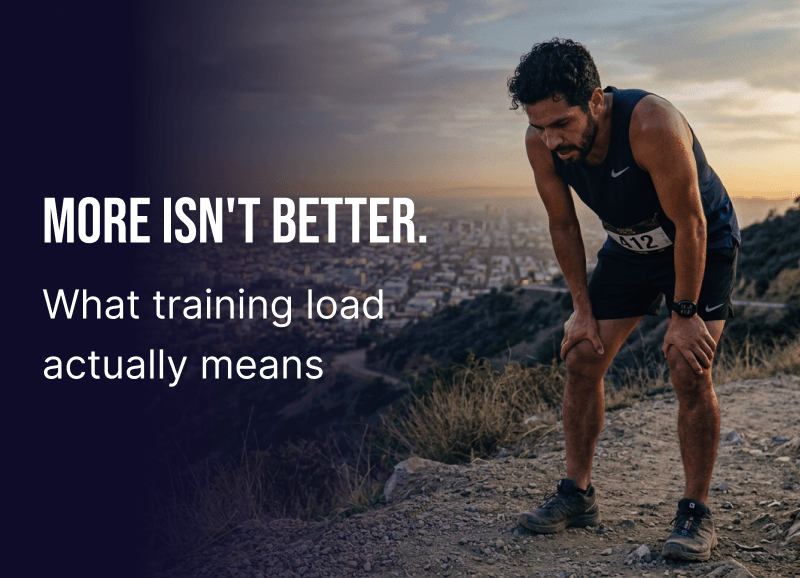
You can run three times a week and improve dramatically. You can also run five times a week and go nowhere. The difference isn't volume. It's load.
Training load is the concept that ties everything together. How much stress you're putting on your body, how consistently, and whether you're actually absorbing it or just accumulating it. If training paces are the what, training load is the how much.
What training load actually means for runners
Training load models the balance between fitness and fatigue. It uses your heart rate data to quantify how hard each session was, then tracks your accumulated fitness versus your recent fatigue to tell you how fresh or fatigued you actually are.
Each session gets a TRIMP score, which stands for Training Impulse, based on how long you ran and how hard your heart was working. A 40 minute easy run might score a TRIMP of 34. A hard 44 minute run might score 74. Distance alone doesn't tell the full story.
Those session scores feed into two numbers that matter most.
CTL, or Chronic Training Load, represents your fitness level built over the past six weeks. It's what your body has actually adapted to handle. If your CTL is low, you're either new to training or returning from a break. If it's high, your body is used to absorbing consistent work.
ATL, or Acute Training Load, measures your training stress over the past week. It's your recent fatigue. How hard have you been pushing lately?
The relationship between those two numbers is where the real insight lives.
TSB: the number that tells you how fresh you actually are
Training Stress Balance, or TSB, is the difference between your CTL and your ATL. It's your freshness score.
When your TSB is positive, your fitness is higher than your recent fatigue. You're fresh and ready to perform. When it's negative, fatigue is outpacing your fitness base and you're carrying more load than you're absorbing.
There are five ranges worth understanding:
Above +15 is peak form. Fully rested, peak race readiness. This is where you want to be on race day.
+5 to +15 is fresh. Ready for quality efforts and hard sessions.
-5 to +5 is balanced. A normal training state where you're doing productive work.
-15 to -5 is fatigued. You're absorbing training load, which is normal during a build, but worth monitoring.
Below -15 is overreaching. High fatigue and real injury risk. Time to prioritize rest.
Most recreational runners spend their entire training lives somewhere between balanced and fatigued without ever knowing it, because they're not tracking it.
Why repeating the same runs every week stops working
If you run the same three runs every week, same distance, same pace, same days, your training load flatlines. Your CTL stops growing because the stimulus isn't changing. Your body has already adapted to that specific stress and has no reason to improve further.
This is different from the plateau that comes from running at the wrong intensity. This is a plateau caused by running the same load repeatedly. The training is no longer a new signal.
To move forward you need to change something deliberately. Add a fourth run, make one run longer, make one session harder, restructure the week. A structured increase of around five to ten percent in weekly load, held for two or three weeks before the next increase, is how fitness builds. Just deciding to run more this week is how people get injured.
How build and recovery cycles actually work
Smart training isn't a straight line upward. It's more of a sawtooth pattern. Build for two or three weeks, then back off for one.
The recovery week is where adaptation actually happens. You've accumulated stress during the build. Now you give your body time to absorb it, repair tissue, and consolidate fitness gains before building again from a slightly higher baseline.
Skipping recovery weeks is one of the most common mistakes ambitious recreational runners make. The temptation is always to keep pushing. But training without recovery is just fatigue accumulation. The gains come during the rest, not the work.
Why you can't always feel when your load is too high
One of the harder things about managing training load is that you can't always sense it accurately. You might feel completely fine at the end of week three of a build, and then feel terrible on day two of a recovery week. Fatigue doesn't show up in a straight line.
This is also where training load connects to everything else in your life. Sleep, stress, nutrition. A hard week of training looks very different if you've been sleeping eight hours versus six. The TRIMP score is the same either way. Your capacity to absorb it isn't.
How Milo tracks your training load automatically
Milo tracks your CTL, ATL, and TSB after every run, so you can see at a glance exactly where you sit across all five ranges. You get a current state summary that tells you whether you're fresh, balanced, fatigued, or overreaching, along with an insight that explains what that actually means for your training right now.
You can see how stress has accumulated over the past six weeks, whether your fitness is trending in the right direction, and whether you're going into a hard session in a state where it's actually going to count.
Instead of guessing whether you've been doing too much or too little, the numbers are just there, updated after every run. That's the difference between training with intention and just hoping the miles add up.