Race Week: How to Prepare for Race Day
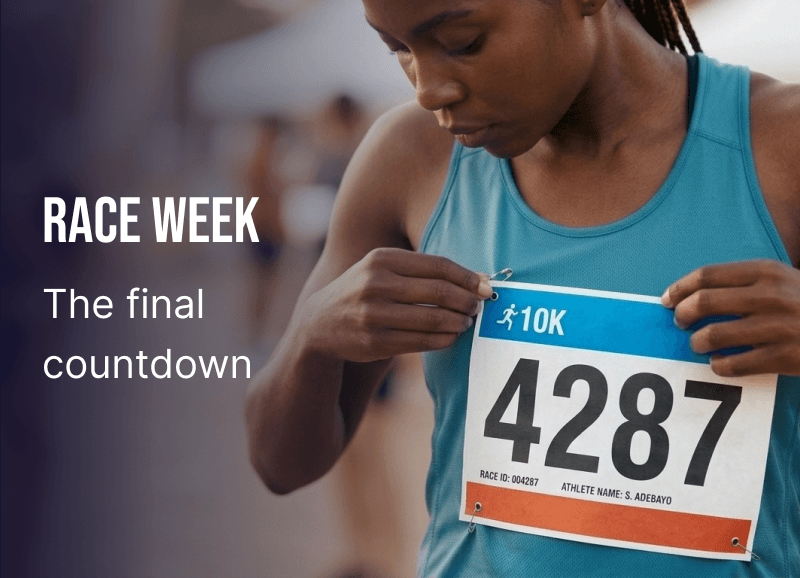
It's race week. The training is done. The taper is in full swing. There's very little you can do this week to improve your fitness, and quite a lot you can do to undermine it.
Race week isn't about getting fitter. It's about getting ready. The decisions you make in these final days, about sleep, food, logistics, and your headspace, determine whether you show up to the start line calm and ready or frazzled and reactive.
Monday through Thursday: keep it boring
The best race weeks are the most uneventful ones. Your body is absorbing the final benefits of the taper, and your job is to not interfere with that process.
Run easy and short. Your plan should have minimal running this week, a few easy shakeout runs of 20 to 40 minutes at a comfortable pace. If you feel good, resist the urge to push it. You're not testing your fitness. You're keeping your legs loose.
Eat normally, with slightly more carbs. You don't need to sit down to a mountain of pasta the night before. Modern carb loading is subtler. Increase your carbohydrate intake by 10 to 20 percent across the whole week. Extra rice at dinner. An extra slice of toast at breakfast. A banana as a snack. The goal is to top off your glycogen stores gradually, not in one overwhelming meal.
Sleep as well as you can. Here's the counterintuitive part: the night before the race, you probably won't sleep well. Pre-race nerves, an early alarm, an unfamiliar bed if you're traveling, it's almost guaranteed to be a rough night. That's okay. The sleep that matters most is two and three nights before the race. Prioritize Monday, Tuesday, and Wednesday. If Thursday night is rough, your body has a buffer.
Hydrate normally. Don't over-drink. Don't under-drink. Maintain your normal fluid intake with a slight emphasis on water and electrolytes. If your urine is pale yellow, you're fine.
The day before: logistics day
This is when you handle everything that isn't running.
Pick up your bib early and get out. Expos are designed to sell you things. You don't need new shoes, new gels, or new compression socks the day before a race. Get your bib, check your number, leave.
Lay out everything. Every single thing you're wearing and carrying on race morning goes out tonight. Shoes, socks, shorts, top, hat, watch, bib, gels, body glide, sunscreen. Pin your bib to your top now. Nothing should require a decision tomorrow morning.
Review the course one more time. Know where the aid stations are. Know where the hills are. Know where the mile markers fall. If there's a long exposed stretch, a sharp turn, or a climb at mile 20, you want to know about it now, not when you're already running it.
Set two alarms. Calculate backwards from your wave start time. Travel to the start, bathroom time, corral positioning, warm-up, and the two to three hours since your pre-race meal. Race mornings are early. There's no being late to a starting line.
Plan your transportation in both directions. Know exactly how you're getting to the start and how you're getting home. Cell service near a race finish is often terrible. Confirm the meeting plan before you need it.
Race morning: execute, don't decide
Everything you do race morning should already be decided. This is not the time for improvisation.
Wake up, get moving, start with water. Eat your pre-race meal, the same one you've been eating before long runs all through training, at the same time interval before the start. Get dressed in exactly what you laid out. Apply body glide. Put your gels where they go.
Arrive earlier than you think you need to. Bathroom lines at race starts are long. Gear check can be slow. Finding your corral in a crowd of thousands takes time. Being early is calm. Being on time is stressed. Being late is a disaster.
Warm up appropriately. For a 5K or 10K, 10 to 15 minutes of easy jogging and a few strides to activate your legs. For a half marathon or marathon, 5 to 10 minutes of walking and light jogging is enough. The race itself serves as the warm-up for longer distances.
The mental side
Race week is when doubt gets loudest. Did I train enough? What if the weather is bad? What if I start too fast?
Some of this is productive. Most of it is noise.
Look back at your training, not to judge it but to appreciate it. The weeks of consistent work. The long runs you completed. The hard sessions you pushed through. The evidence of your fitness is in what you did, not in how you feel this week.
Have a race plan, not just a goal. A finish time is an outcome. A race plan is a process. Know your target pace for the first mile, the middle miles, and the closing miles. Know when you're taking gels. Know what you'll do if it's hotter than expected or windier than forecast. A plan gives you something to execute instead of something to worry about.
And accept that it won't be perfect. No race ever goes exactly according to plan. The runners who race well aren't the ones who have perfect days. They're the ones who adapt calmly when something goes sideways.
You've prepared for this
You chose the right race. You built your mileage carefully. You dialed in your nutrition. You tested your gear. You respected the taper. And now, in race week, all of that preparation comes together.
Milo was with you through every step of it.
When you first connected your running history, Milo built a picture of your fitness from day one. Your VO2 max trend, your training load history, your sleep, your recovery patterns. It set your training paces based on where your fitness actually was, not where you hoped it was, and updated them automatically as you got faster.
Through the build, it tracked your CTL climbing week over week, showing you that the work was accumulating the way it was supposed to. When your TSB dipped into negative territory during peak training weeks, that wasn't a warning sign. It was confirmation that you were pushing hard enough to create real adaptation. Milo showed you that.
Then the taper started and you watched your TSB climb back toward positive. From overreaching to fatigued to balanced to fresh. That progression wasn't just something you felt. You could see it. And seeing it made it easier to trust the process rather than second-guess it.
Your readiness assessment told you day by day whether your body was absorbing the training or still carrying fatigue. Your sleep trends showed you whether your recovery was keeping pace with your workload. Your training load balance told you whether you were building sustainably or quietly digging a hole.
All of that information, updated after every run, in one place, meant that every decision you made through this training cycle was grounded in something real. Not guesswork. Not generic advice from a static plan. Your data, your fitness, your readiness.
And on race morning, Milo is on your wrist. Real-time pacing. Live stats. Everything you need to execute the plan you've spent months building toward.
You've done the work. Milo helped you do it right. Now go race.